

What is a BiDi transceiver?
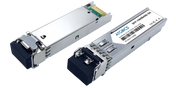
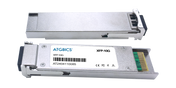
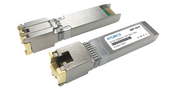
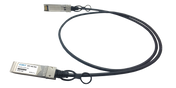
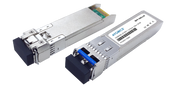
A BiDi, or Bi-Directional, transceiver is an optical module that simultaneously transmits and receives data over a single strand of fibre. These devices hold many benefits over traditional technologies while still being compact, reliable and cost effective. This article explores how BiDi technology works and why it is such a common choice for modern high density network deployments.
How does BiDi work?
BiDi transceivers work by using Wavelength Division Multiplexing (WDM) which allows them to transmit upstream (Tx) traffic on one wavelength, and receive downstream (Rx) traffic on another, all over a single fibre link at the same time. A WDM coupler (also called a diplexer) in each transceiver manages the separation and combination of these signals.
BiDi transceivers must always be deployed in matching pairs, with one unit at each end of the link transmitting/receiving opposite wavelengths. For example, some BiDi transceivers, like our Cisco® compatible GLC-BX-U-C, use a transmit (Tx) wavelength of 1310nm and a receive (Rx) wavelength of 1490nm, while its downstream counterpart GLC-BX-D-C does the opposite. Other than their opposing Tx and Rx wavelength values, the corresponding transceivers are functionally and structurally identical.

Inside a BiDi Transceiver: The BOSA
The Bi-Directional Optical Subassembly (BOSA) refers to the internal structure that makes BiDi devices unique. Standard duplex transceivers keep the TOSA (Transmitter Optical Subassembly) and ROSA (Receiver Optical Subassembly) in separate ports where one manages the transmit fibre and the other manages the receive fibre. A BOSA combines these with the diplexer routing signals to the correct place, requiring only a simplex connector port.
The core components of a BOSA (Bi-Directional Optical Subassembly) include:
- Laser Diode – generates optical transmit signal at the designated Tx wavelength
- Photodetector/PIN Photodiode – converts receive (Rx) optical data back into electrical signals
- Optical Lens – Focuses light onto the fibre
- WDM Diplexer – Critical component for BiDi transmission simultaneously routing Tx signal onto the fibre and Rx signal to the photodetector

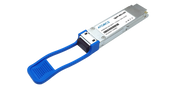
Not all BiDi transceivers use a simplex connector. Higher speed devices like 40G QSFP+ BiDi use a duplex LC interface, but it functions differently to traditional duplex transceivers. Each fibre strand is treated as a bidirectional path, effectively splitting the data stream between two simplex BiDi ports. In this case a 40G BiDi transceiver will use a duplex LC connector with two 20Gbps BiDi channels.
Why Use BiDi Transceivers?
Increase network capacity
BiDi Transceivers can effectively double network capacity over the same fibre infrastructure. Where a six-strand fibre would normally have three allocated to upstream and three for downstream signals, BiDi technology enables each strand to host both, resulting in six bidirectional data streams.
Lower Infrastructure and Running Cost
Halving fibre requirements directly impacts the entire network:
- Fewer cables and physical ports reduce procurement, installation and maintenance costs
- Lower overall power consumption from reduced network components
- Simplified cabling reduces physical space requirements and makes infrastructure easier to manage
Reliability and Flexibility
Fewer physical connections mean fewer potential points of failure while simplifying fault diagnosis and general maintenance. Additionally, network congestion is reduced while enabling higher throughput.
Upgrading systems is more streamlined as incremental transceiver upgrades can drastically improve bandwidth without replacing the fibre backbone. Fibre cabling is designed to last for decades and so can support networks through multiple upgrade cycles.
ATGBICS Solutions
ATGBICS offers a comprehensive range of BiDi transceivers including data rates from 100Mbps to 100Gbps and reach options up to 120km. Our compatibles support infrastructures from key vendors like Avago Broadcom, Cisco, Juniper, Finisar and more with commercial, extended and industrial grade solutions available.
All our transceivers are manufactured to MSA standards meaning guaranteed compatibility and equivalent functionality to OEM original parts. Additionally, all our products are backed by a lifetime replacement warranty.
View our full range or get in contact to find the best module for your requirements.